

How to make a summary

Adriana Nieto
July 15, 2020
Understanding a text is not always an easy task, especially when dealing with scientific articles, academic books, research papers, or very long texts that use technical language. In these cases, it is common to feel overwhelmed by the amount of information, which is why applying study techniques makes a significant difference in achieving meaningful learning.
One of the most effective tools for this purpose is the summary, as it allows us to analyze, organize, and synthesize the most relevant information in a text. Knowing how to summarize not only makes studying easier, but also helps strengthen reading comprehension and analytical skills. Below, we will explain what a summary is, its elements, the key steps to follow, the different types of summaries you may encounter, and an online tool for summarizing texts.
What Is a Summary?
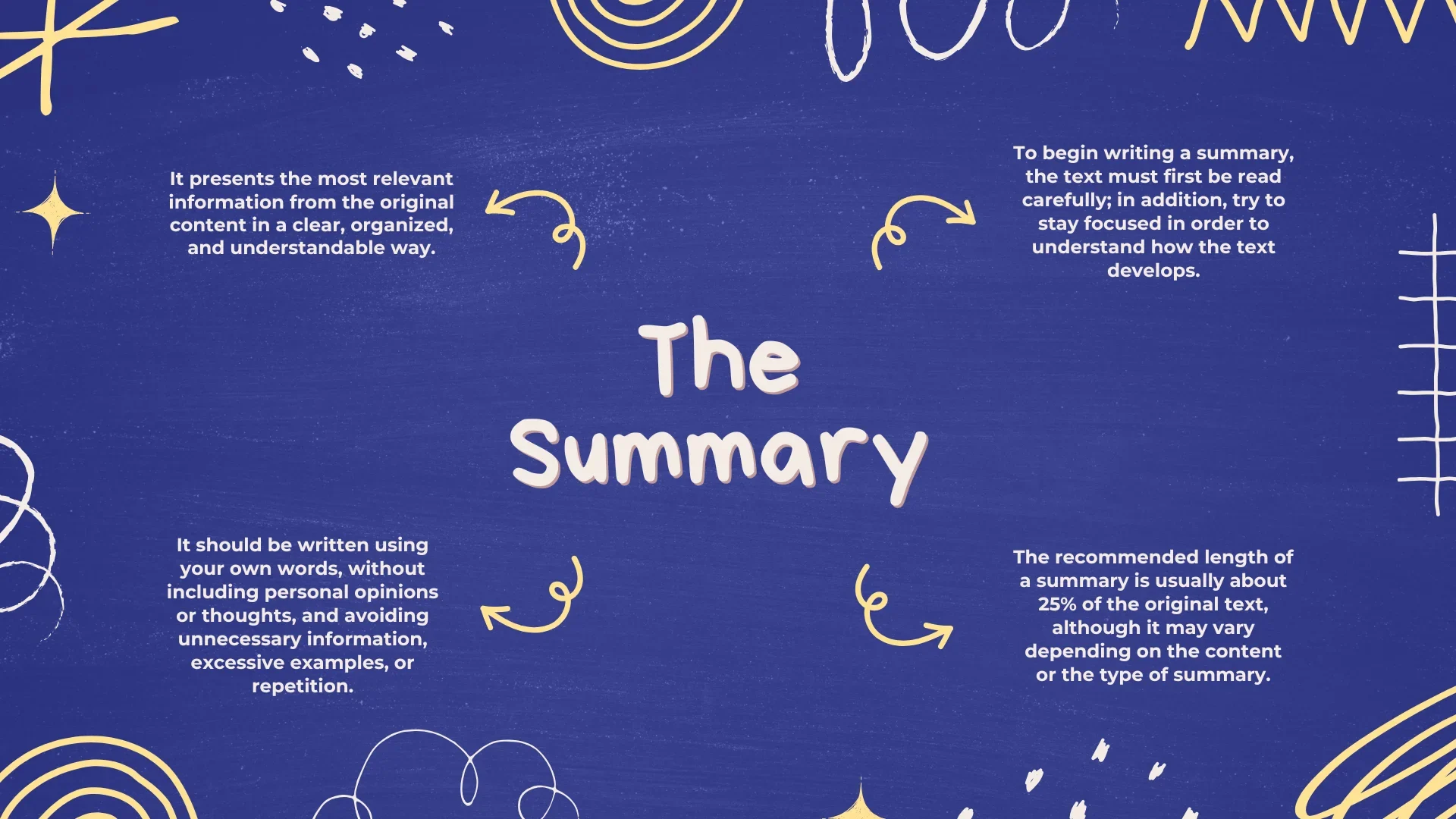
A summary is a brief and condensed version of an original text that preserves its main ideas and original meaning. It is used to present the most relevant information in a clear, organized, and understandable way. Identifying the main idea of the original text is essential, and you should not deviate from it when creating the summary.
For a summary to be effective, it must be written using your own words, without including personal opinions or thoughts, and avoiding unnecessary details, excessive examples, or repetition. In general terms, a summary is usually about 25% of the length of the original text, although this may vary depending on the content or type of summary.
Steps to Write a Summary
Sometimes, the information covered within a selected topic is excessive, making it difficult to remember everything accurately. For this reason, here is how to write a summary without failing:
Read and fully understand the original text: To begin writing a summary, you must first read the text carefully. Try to stay focused in order to understand how the text develops. As you read, analyze the information and identify key data.
Identify main and secondary ideas: Using a highlighter, separate the main ideas, secondary ideas, and supporting details of each paragraph. You can mark key concepts, important definitions, or specific data.
Transcribe the ideas: In a separate notebook or on a blank sheet of paper, write down the ideas from the previous step and try to create coherent paragraphs.
Final writing: It is normal to add or remove some ideas between this step and the previous one, as long as you keep only the most important ones. Write the summary using your own words and avoid copying full sentences.
If you need visual support or want to improve coherence, you can add this extra step:
Create an outline and draft: This step is more detailed and careful. Before writing the final version, you can create an outline as a working tool to make the topic easier to understand. Use a concept map, a mind map, or summary cards.
Elements of a Summary
Every well-structured summary should include essential elements that provide form and coherence.
Summary Title
Yes, your summary should have a title to clearly indicate to the reader what the text is about.Introduction
The introduction briefly and generally presents the topic of the original text and provides context for the reader.Body (Synthesis)
This is the core of the summary. Here you present the most relevant main and secondary ideas from the text, organized logically and coherently.Conclusion
This section restates the main idea of the text and closes the summary in an organized way. It may emphasize the central message or the most important contribution of the original content, without personal opinions.References
In academic summaries, it is important to mention the source of the original text or any additional sources consulted.
How to Write a Good Summary
In addition to following a series of steps, writing a good summary requires keeping in mind some key recommendations that will help improve its overall quality.
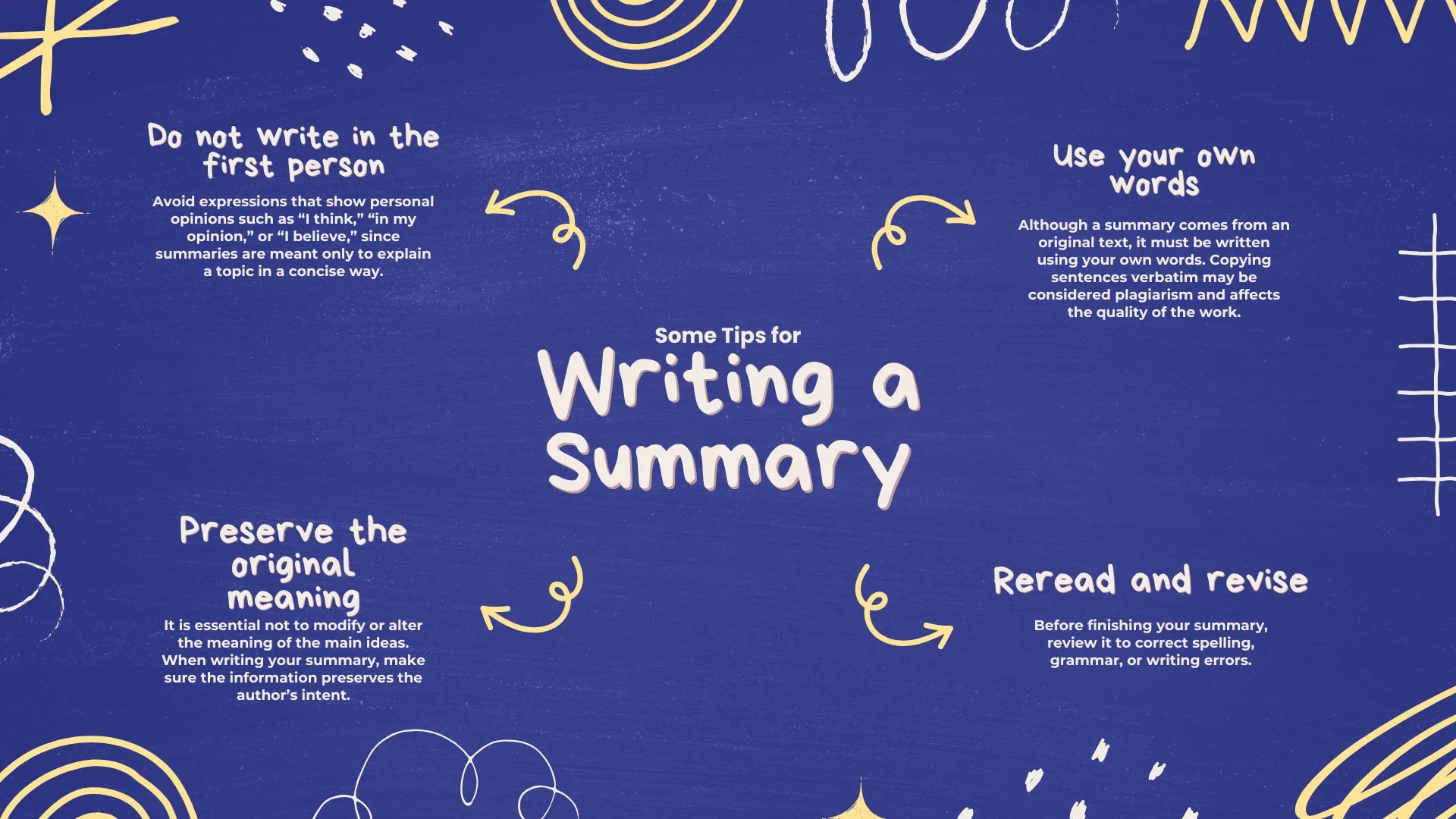
Avoid writing in the first person
A summary should maintain an objective tone. Avoid expressions that show personal opinions such as “I think,” “in my opinion,” or “I believe,” since summaries aim only to explain a topic in a concise way.Use your own words
Although a summary is based on an original text, it must be written in your own words. Copying phrases verbatim may be considered plagiarism and reduces the quality of the work. If you find it difficult to rephrase a sentence, you can use a text rewriter.Respect the original meaning of the text
It is essential not to modify or alter the meaning of the main ideas. When writing your summary, make sure the information preserves the author’s intent and is not taken out of context.Maintain order and coherence
For your summary to make sense, ideas must follow a logical order (or the original order). Remember that texts are usually structured from general to specific.Reread and revise
Before finishing your summary, review it to correct spelling, grammar, or writing errors. If you are short on time, you can use an online spell checker.
Key Points of a Good Summary
For a summary to fulfill its purpose, it must consider the following aspects:
Originality: It should be written in your own words (without personal opinions) and without copying sentences verbatim.
Informative: It must include the most important ideas from the original text in a coherent and organized way.
Accuracy: The meaning or context of the original text should not be altered.
Types of Summaries
Writing a summary is not as simple as it seems. There are several types of summaries with different uses and structures, but all share the same goal: learning. Choosing the right type depends on the purpose of the summary, the type of original text, and the context.
Below are the most important and commonly used types of summaries that may be useful in the future.
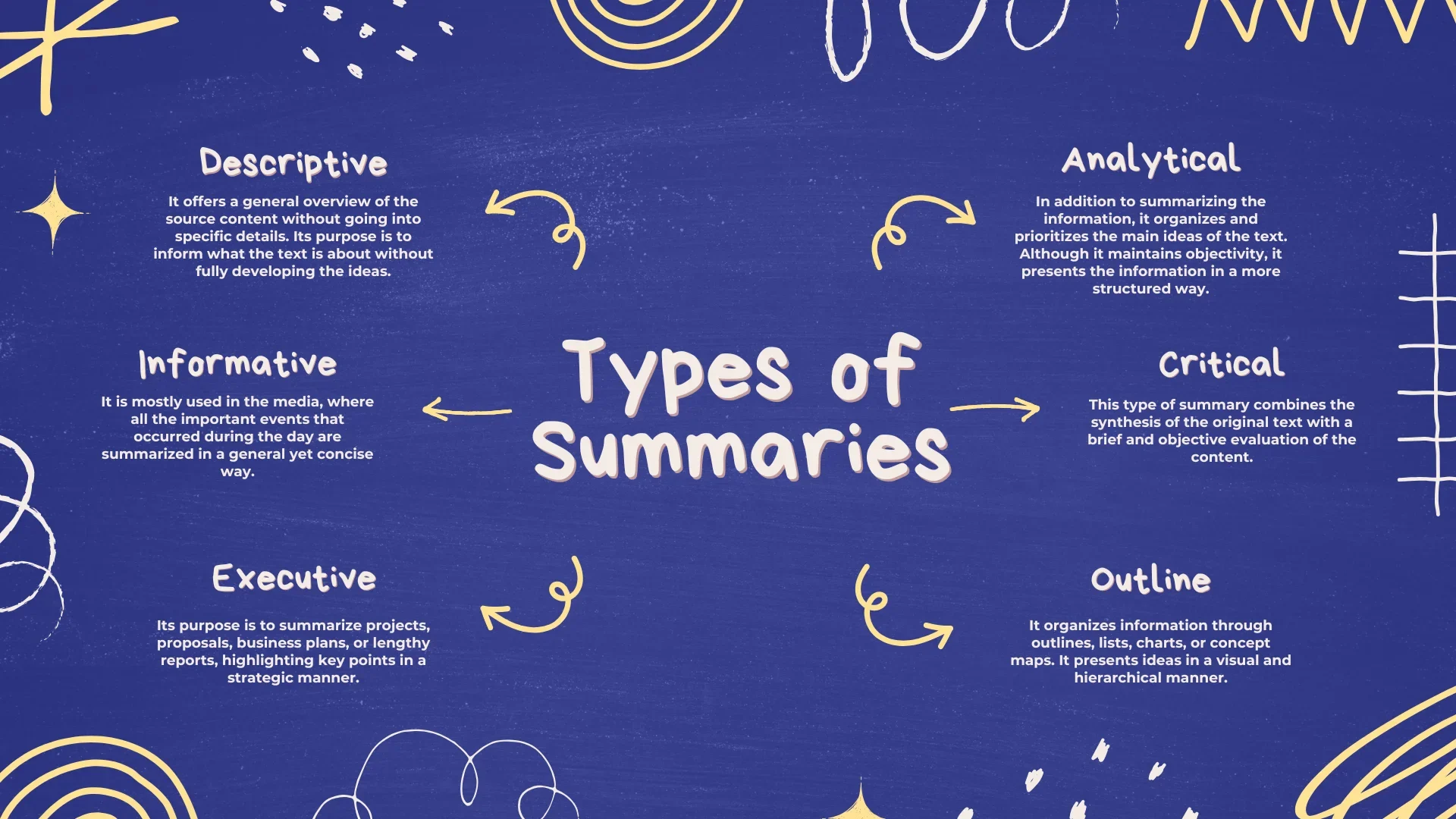
Descriptive Summary
Also known as an indicative summary, this type provides a general overview of the source content without going into specific details. Its main objective is to inform what the text is about without fully developing its ideas.
It is frequently used in books, academic articles, catalogs, or bibliographic records. It follows the order of the original text and is usually brief, highlighting only the central topic.
Informative Summary
An informative summary presents the main ideas and most relevant data of the text clearly, concisely, and completely. It is commonly used in the media, where important events of the day or week are summarized in a general yet concise way, as seen in news broadcasts.
Executive Summary
As its name suggests, this type is widely used in business, administrative, or financial contexts. Its objective is to summarize projects, proposals, business plans, or lengthy reports by highlighting key points strategically.
It is designed for decision-makers, so it must be clear, persuasive, and direct.
Analytical Summary
In addition to synthesizing information, the analytical summary organizes and prioritizes the main ideas of the text. Although it maintains objectivity, it presents the information in a more structured and in-depth manner.
It is mainly used in academic contexts, research, or university assignments where demonstrating comprehension of the content is important.
Critical Summary
This type of summary combines the synthesis of the original text with a brief and objective evaluation of its content. What distinguishes it from other summaries is that it may include observations about the relevance or contributions of the text.
It is common in academic reviews, book analyses, and scientific articles.
Outline Summary
This type organizes information using outlines, lists, tables, or concept maps. It is not always written as a continuous text; instead, it presents ideas visually and hierarchically.
Use a Text Summarizer as Study Support
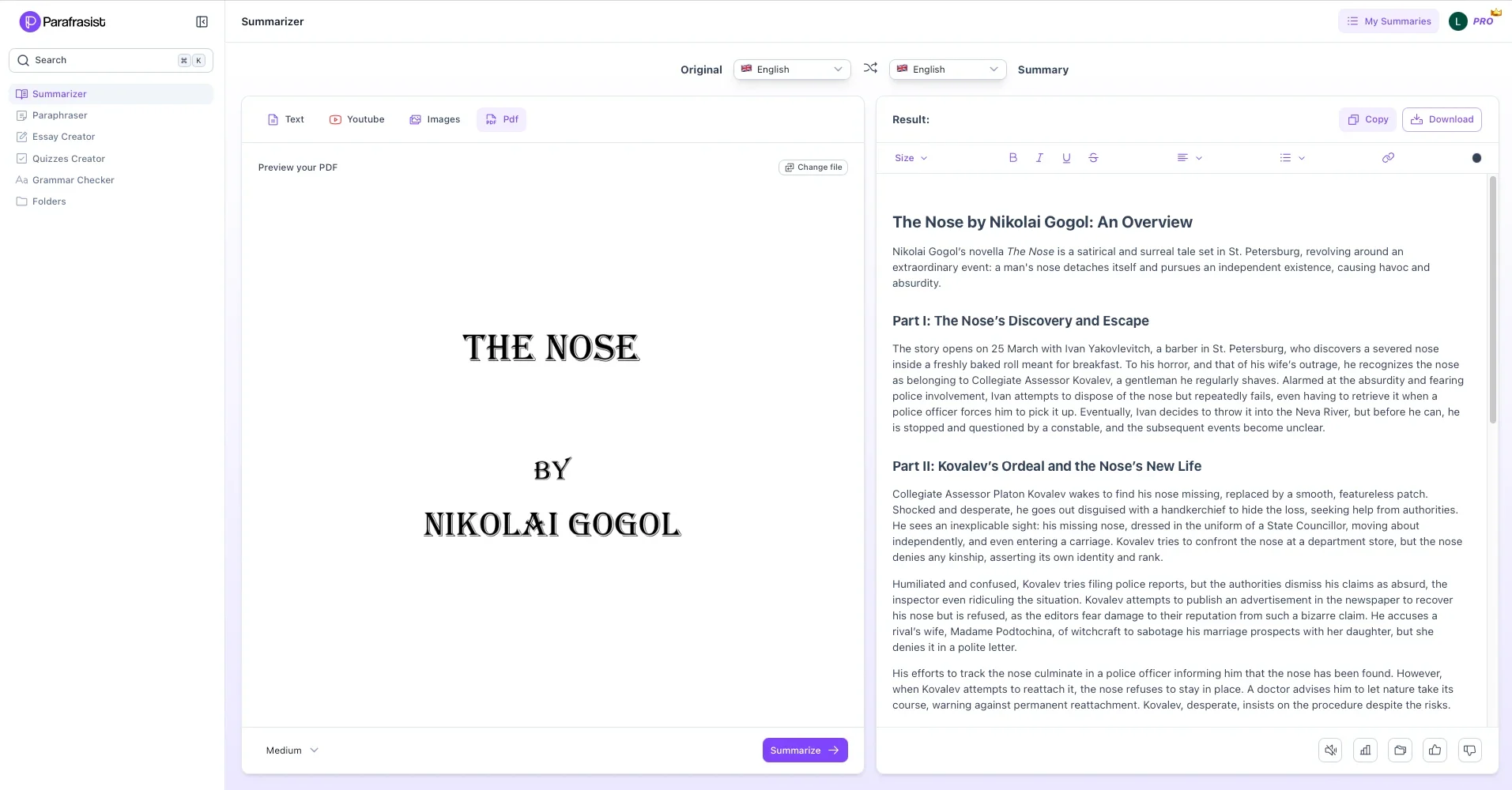
Although mastering summarization techniques is essential, today there are digital tools that can help in the process. A text summarizer allows you to shorten very long content quickly while keeping the main points intact.
The best one is Parafrasist! On this platform, you can summarize academic texts, lengthy PDFs, images such as infographics, and even YouTube videos without compromising your learning. It is designed for students like you who want to optimize study time and improve reading comprehension.
Learning how to write a good summary is an essential skill for studying and for any academic work. It is not just another task—summarizing allows you to fully understand texts, organize ideas, and improve academic performance. Whether done manually or with the help of tools like Parafrasist, mastering this technique will help you study more effectively.