
Paraphrase and paraphrase: Know how to do it in one place

Adriana Nieto
July 31, 2020
There is a world of possibilities and ideas to understand a text in order to give it the correct interpretation without losing coherence—especially when, in academic settings, we face long readings, complex concepts, or ideas that need to be reinterpreted to achieve true understanding. In these cases, paraphrasing becomes a fundamental tool for learning more effectively, writing clearly, and respecting the coherence of the text.
The act of paraphrasing allows you to express an idea using your own words without altering its meaning. Thanks to this technique, it is possible to paraphrase a text, adapt it to simpler language, and improve reading comprehension, whether for school assignments or professional research. Throughout this blog, we will explain in detail everything you need to know about paraphrasing, how to paraphrase texts correctly, and a useful insight on how to paraphrase online.
What Is Paraphrasing?
Paraphrasing is a reading comprehension technique that consists of explaining or reformulating a text using your own words without changing the original message. Its main objective is to facilitate understanding of the content while maintaining coherence and the meaning of the information.
It is very important to understand that paraphrasing is not summarizing, nor simply replacing a few words with synonyms or changing words at random. Instead, it involves truly analyzing the text in order to express it in a different, clearer, or more understandable way. This is why paraphrasing is an essential skill in academic contexts, as it allows you to demonstrate that you understand the content without copying it verbatim.

Meaning of Paraphrasing
The term paraphrase comes from the Greek words para, meaning “beside,” and phrasis, meaning “expression” or “speech.” It can be interpreted as an “additional expression” or “explanation.” In practice, the meaning of paraphrasing is related to the ability to reinterpret a text using more accessible or colloquial language.
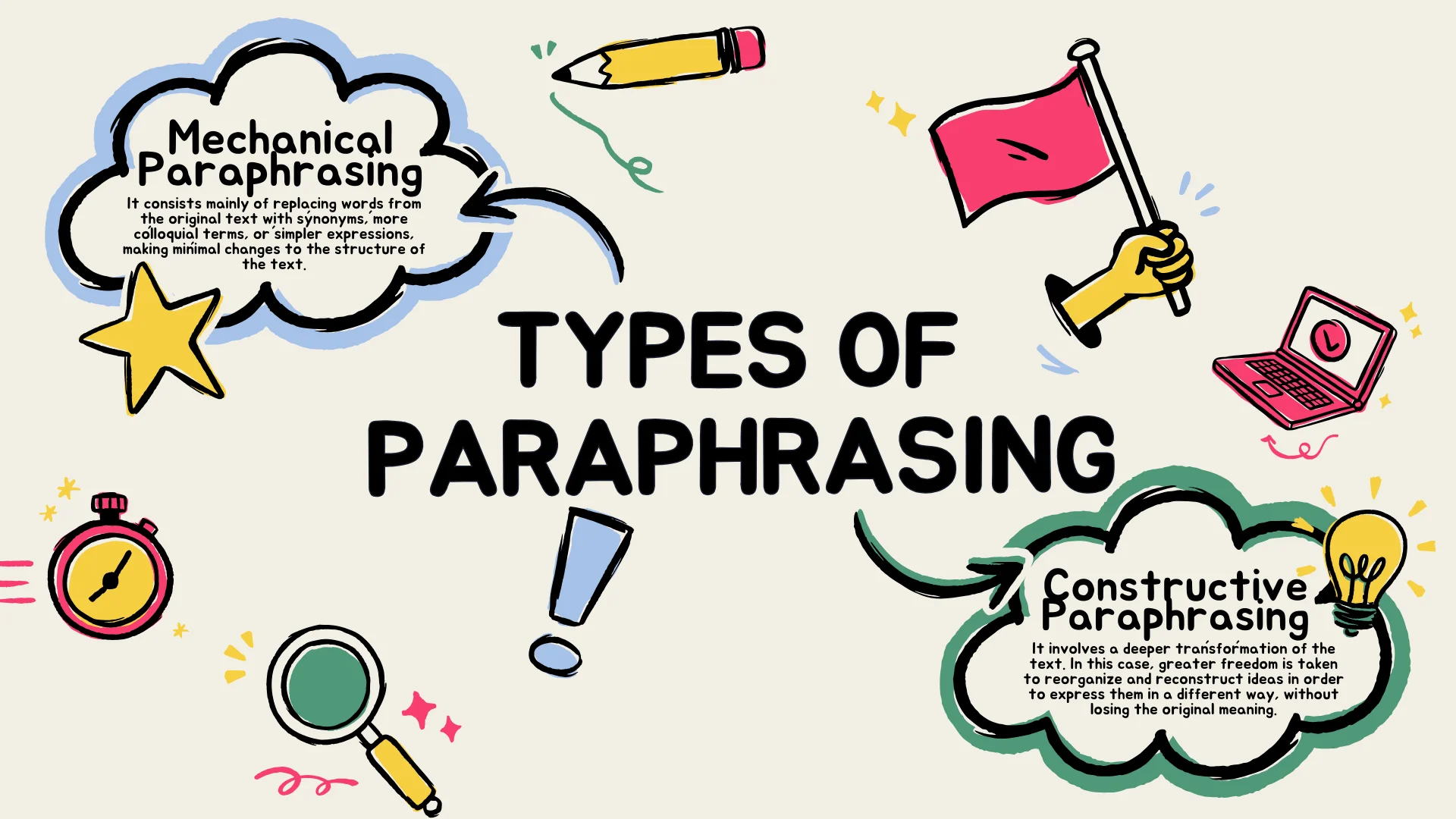
Types of Paraphrasing: Mechanical and Constructive Paraphrasing
There are two types of paraphrasing, and the difference between them depends on the level of modification or transformation applied to the original text.
Mechanical Paraphrasing
This type of paraphrasing consists mainly of replacing words in the original text with synonyms, simpler terms, or more colloquial expressions, making minimal changes to the structure. Although the meaning is preserved, it is usually a very superficial form of paraphrasing.
Example:
Original text: Constant reading improves students’ comprehension and vocabulary.
Mechanical paraphrase: Frequent reading increases students’ comprehension and vocabulary.
Constructive Paraphrasing
Constructive paraphrasing involves a deeper transformation of the text. In this case, greater freedom is taken to reorganize and reconstruct ideas in order to express them differently, without losing the original meaning.
Example:
Original text: Constant reading improves students’ comprehension and vocabulary.
Constructive paraphrase: Developing a regular reading habit allows individuals to enhance their reading comprehension skills and expand their language knowledge.
Why Paraphrase Texts?
Paraphrasing texts offers many benefits in both academic and professional settings. This technique allows you to:
Improve reading comprehension
Avoid plagiarism in written assignments
Adapt texts to simpler language
Reinforce learning by reinterpreting information
Expand linguistic knowledge when studying another language
When you learn to paraphrase correctly, you not only write better—you also understand the content you study more deeply.
How to Paraphrase
Paraphrasing is simple, but to do it well, certain steps must be followed. First, the original text must be read very carefully until its meaning is fully understood. Then, the main ideas are identified and rewritten or reinterpreted using your own words, depending on the level or type of paraphrasing (mechanical or constructive) you want to apply.
Finally, it is essential to review the text to ensure it preserves the original meaning and is well written.
Paraphrasing: Examples
To make everything perfectly clear, here are some paraphrasing examples:
Original text:
“He who fights with monsters should look to it that he himself does not become a monster. And if you gaze long into an abyss, the abyss also gazes into you.” — Friedrich Nietzsche
Paraphrase:
Anyone who battles monsters must be careful not to turn into one. And if you stare into an abyss for a long time, the abyss will also stare back at you.
Original text:
“Education is the most powerful weapon which you can use to change the world.” — Nelson Mandela
Paraphrase:
Through education, people have the ability to create profound changes in society.
Original text:
“Imagination is more important than knowledge.” — Albert Einstein
Paraphrase:
Imagination holds greater importance than knowledge.
Online Paraphrasing: An AI Tool for Paraphrasing
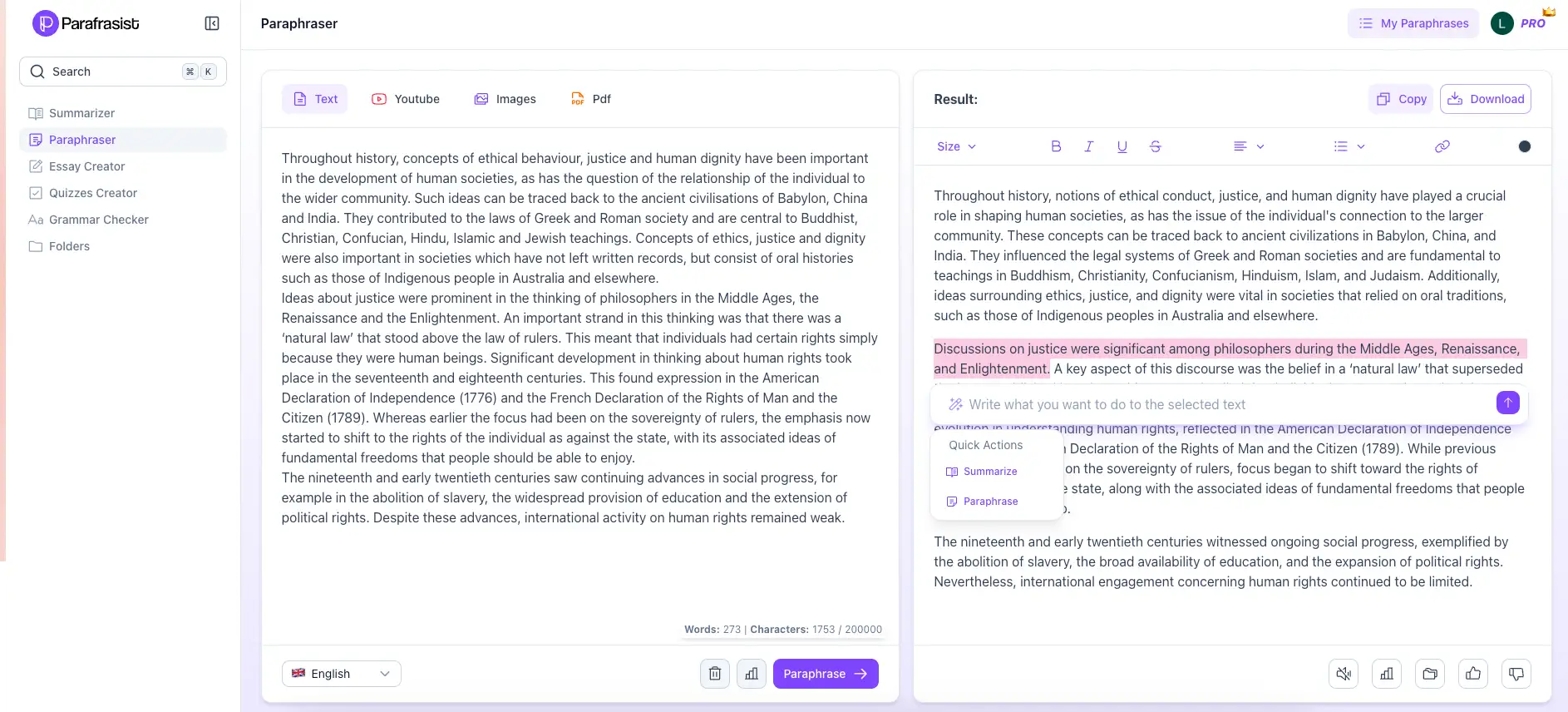
The modern world continues to evolve, and with technological advances, tools have emerged that allow paraphrasing to be done quickly and with minimal effort. For this reason, we created a tool that enables you to paraphrase texts online, making the process easier and more efficient.
With Parafrasist, you can paraphrase any text using an artificial intelligence–based tool. This platform allows you to reformulate long or complex texts in seconds while maintaining coherence and the original meaning. It is ideal for students who want to optimize their time, improve reading comprehension, and study without complications.
Paraphrasing is an essential skill for understanding texts, improving writing, and strengthening learning. Knowing how to paraphrase correctly allows you to express ideas more clearly, avoid plagiarism in academic work, and develop your own voice.
Whether you choose to paraphrase manually or with the support of digital tools like Parafrasist, mastering this skill will help you approach academic assignments and professional projects with greater confidence.