

Tricks to better understand a text, in a short time!

Adriana Nieto
August 2, 2020

Understanding a text is not always an easy task. You have probably experienced reading an entire book, an academic article, a scientific journal, or simply a text to study for an exam, only to face difficulties such as overly long content, complex vocabulary, poorly organized ideas, or concepts that go unnoticed. All of these issues can make reading feel heavy and ineffective.
However, better text comprehension is a skill that can be developed through practice and the use of appropriate techniques. In this blog, we will share tips, advice, and exercises that will help you improve your reading comprehension in a short time, optimize your study process, and make better use of every reading, regardless of its level of difficulty.
Reading Comprehension: What Is It?
Reading comprehension is the ability to understand, analyze, and interpret the information contained in a text. It is not just about reading words, but about grasping their meaning, connecting ideas, and reflecting on the content. Good reading comprehension allows you to study more efficiently, remember information better, and apply it in different academic contexts.
When reading comprehension fails, studying becomes slower and more frustrating. If you do not understand or retain what you read, much of your effort becomes ineffective. For this reason, developing this skill is essential to improving academic performance at both school and university levels, as well as acquiring new knowledge independently.
Levels of Reading Comprehension
Reading comprehension is complex, which is why it does not occur in just one way. Instead, it develops across different levels that reflect how deeply we understand a text. Identifying these levels will help you recognize how complete your reading process is and which areas you can improve.
Literal Level
This is the most basic level of reading comprehension. At this level, the reader identifies information that appears explicitly in the text, such as definitions, facts, characters, dates, or main ideas that are clearly stated. It does not require deep interpretation—only attention.
Inferential Level
The inferential level involves a greater degree of analysis. Here, the reader interprets implicit information in the text—what is not directly stated but can be inferred from context. At this level, relationships between ideas are established, conclusions are drawn, and indirect meanings are understood.
This level of comprehension is especially important in narrative, argumentative, and academic texts, as it allows the reader to understand the message beyond the literal words.
Critical Level
The deepest level of reading comprehension is the critical level. At this stage, the reader not only understands and interprets the text, but also analyzes, evaluates, and makes judgments about its content. The validity of the information, the author’s intent, and the coherence of the arguments are questioned.
This level is essential during your academic journey, as it encourages critical thinking, reflection, and the ability to argue with solid reasoning.

Types of Reading
The type of reading you do directly influences text comprehension. Depending on your goal, different reading strategies can be applied to improve understanding and optimize time.
Exploratory Reading
This type of reading is done quickly to gain a general overview of the text. It involves reviewing titles, subtitles, introductions, and conclusions to identify the main topic and the structure of the content.
Comprehensive Reading
This type of reading aims to fully understand the content of the text. It involves careful and attentive reading, focusing on the meaning of each idea, and is often supported by techniques such as highlighting, note-taking, or creating summaries.
If you are studying for an exam, this is the most suitable type of reading.
Critical Reading
Critical reading goes beyond basic comprehension. In this type of reading, the text is analyzed, information is evaluated, and its relevance and accuracy are reflected upon. The author’s ideas are questioned and compared with prior knowledge. This approach is especially valuable in academic contexts, where strong analytical skills are required.
In short, exploratory reading is used to gain a general idea of a text, comprehensive reading seeks to fully understand each concept, and critical reading allows you to evaluate and question the information presented.
Exercises to Improve Reading Comprehension
Improving reading comprehension requires consistent practice. Performing specific exercises along with the right techniques helps train the mind to process information more effectively and retain it more easily.
Practical Exercises for Reading Comprehension
Questions and answers:
Select a section of the text (preferably a long one) and ask yourself the same questions journalists use: what? who? how? when? where? Then write the answers. This will help you analyze how much you truly understood.Summarize the text:
Once you have read the entire text, identify the main and supporting ideas. Using your own words, create coherent paragraphs that result in a concise synthesis of the content.
Techniques
Applying techniques while reading is key to improving reading comprehension and making better use of study time. Below are some of the most effective techniques:
Highlighting
Highlighting or underlining key words helps quickly identify the most important concepts in a text. This technique focuses attention on the main ideas and makes it easier to create summaries or outlines later. Avoid over-highlighting—mark only essential ideas.
Looking for synonyms
When a text contains unfamiliar words or complex terms, searching for synonyms or definitions is essential for understanding. This makes reading smoother and clearer. This technique is especially useful for academic, scientific, or older texts. You can also use an online tool like Parafrasist, which helps rewrite texts in clearer language without losing the original meaning.
Creating mind maps, concept maps, or outlines
Transforming text information into diagrams, charts, or concept maps helps organize ideas visually. This technique improves memorization and helps connect concepts in a clear and structured way.

Tips
In addition to techniques, here are some practical tips that can make a big difference when reading or studying a text:
Read in a suitable environment (and read often)
Developing a reading habit greatly improves concentration and vocabulary. Having a quiet, well-lit, and distraction-free space helps you focus and retain information more effectively.Set a reading goal
Before you start reading, define what you want to achieve: studying for an exam, creating a summary, or reading for enjoyment. Having a clear goal guides your reading and makes the process more efficient.Divide the text into parts
Reading a long text in one sitting can be overwhelming. Dividing it into smaller sections makes comprehension easier and prevents information overload.
Summarizing: The Best Technique to Improve Reading Comprehension
As mentioned earlier, one of the most common and effective strategies for understanding a text is summarizing. A summary involves identifying the main ideas and expressing them clearly in your own words while preserving the original meaning. By summarizing, you demonstrate comprehension and organize information logically.
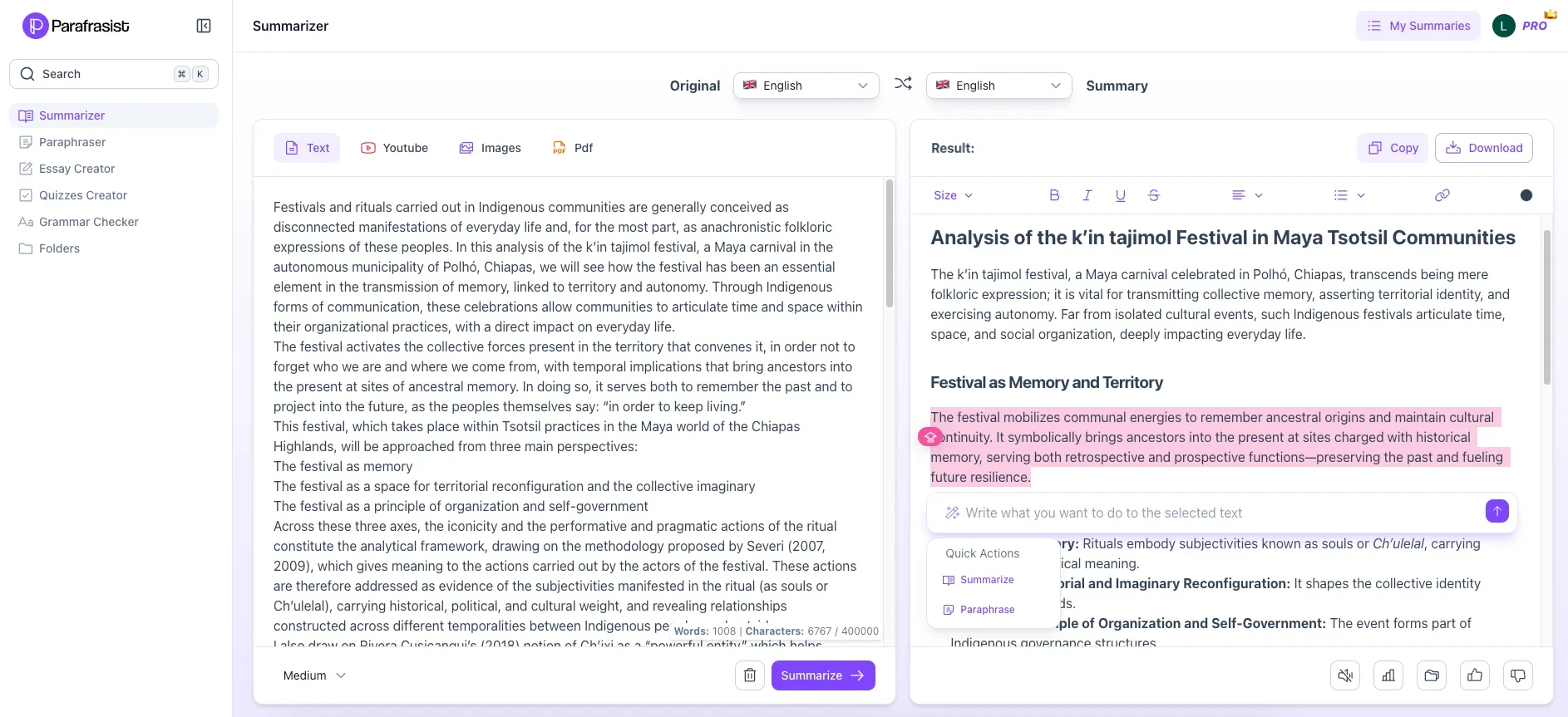
Although summarizing may seem time-consuming or difficult, there are now digital tools that simplify the process. Platforms like Parafrasist generate summaries of texts, PDF documents, YouTube videos, and even images such as infographics or photos of your notes by simply uploading or pasting them. This helps optimize study time and improve reading comprehension. You can even write your own summary first and then use Parafrasist to check whether any important ideas or details were missed.
Studying a text more effectively in less time is possible, especially when you apply the right techniques and develop mindful reading habits. Improving comprehension not only makes studying easier but also strengthens key skills such as analysis, memory, and writing.
Applying strategies such as highlighting, searching for synonyms, reading regularly, and summarizing will help you overcome any academic challenge. Additionally, using tools like Parafrasist will make working with long or difficult texts much easier. Simply visit the homepage and start using the powerful tool has for you.